


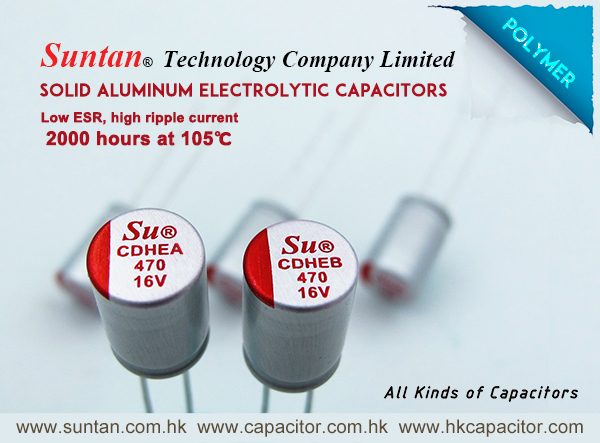
Suntan Solid Aluminum Electrolytic Capacitors

Table of Contents
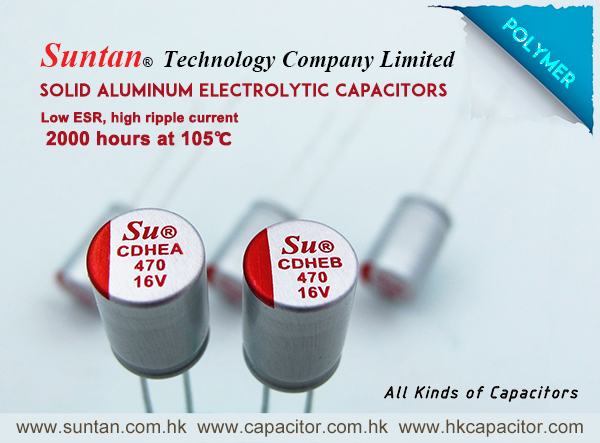
Why Low ESR Polymer Capacitors Are Replacing Liquid Electrolytics in High-Frequency Power Design
TL;DR: The shift toward high-frequency switching power supplies and compact DC-DC converters is accelerating the adoption of low ESR polymer aluminum capacitors due to their superior ripple performance, thermal stability, and longer operational life.
Power Electronics Are Moving to Higher Switching Frequencies
Modern power architectures in servers, telecom equipment, industrial automation, and computing platforms are migrating to higher switching frequencies to improve efficiency and reduce magnetic component size. This trend increases the demand for capacitors with lower ESR and better high-frequency impedance characteristics.
Limitations of Traditional Liquid Electrolytic Capacitors
Conventional liquid aluminum electrolytic capacitors exhibit higher ESR and reduced performance at high frequencies. Their electrolyte evaporation mechanism also limits lifetime in high-temperature environments, which is a critical constraint in dense power designs.
Polymer Capacitors as the Preferred Solution
Conductive polymer aluminum capacitors provide ultra-low ESR, higher ripple current capability, and stable impedance across a wide frequency range. These characteristics make them suitable for modern VRM modules, DC-DC converters, and high-density switching power supplies.
Key Technology Advantages Driving Adoption
- Ultra-low ESR for reduced output ripple
- Improved transient response in dynamic load conditions
- Higher ripple current handling capability
- Longer operational life without electrolyte dry-out
- Better thermal stability in compact PCB layouts
High-Growth Application Segments
- Server and data center power delivery
- Telecom base station power modules
- Industrial DC-DC converters
- Gaming and high-performance computing motherboards
- Automotive power electronics
Design Trend: Hybrid Capacitor Networks
Many power designers are adopting hybrid capacitor banks that combine polymer capacitors for low ESR and MLCCs for high-frequency decoupling. This approach optimizes impedance across a broad frequency spectrum while improving system reliability.
Implications for Component Selection
As switching frequencies continue to increase, selecting capacitors based solely on capacitance value is no longer sufficient. Engineers must evaluate ESR, ripple current rating, impedance vs frequency, and thermal endurance to meet modern power integrity requirements.
Reference: Polymer Aluminum Capacitor Technology
For detailed electrical characteristics and application guidance, refer to the polymer capacitor datasheet:
Polymer Aluminum Capacitor Datasheet
Conclusion
The transition toward high-frequency, high-density power systems is driving rapid adoption of low ESR polymer capacitors. Their performance advantages in ripple suppression, thermal stability, and lifespan make them a key component in next-generation power electronics.