



Table of Contents
Varistor Selection Guide for Transient Voltage Protection
Varistors are voltage-dependent resistors widely used for
transient overvoltage protection in power and signal lines.
When a surge occurs, the varistor clamps the voltage to a safe level,
preventing damage to downstream components.
Working Principle
A varistor exhibits high impedance under normal operating voltage.
Once the voltage exceeds its varistor voltage (V1mA),
its resistance drops rapidly and it conducts surge current,
acting as a bidirectional protection device.
This behavior enables effective suppression of
ESD, EFT and lightning-induced transients.
Varistor Types
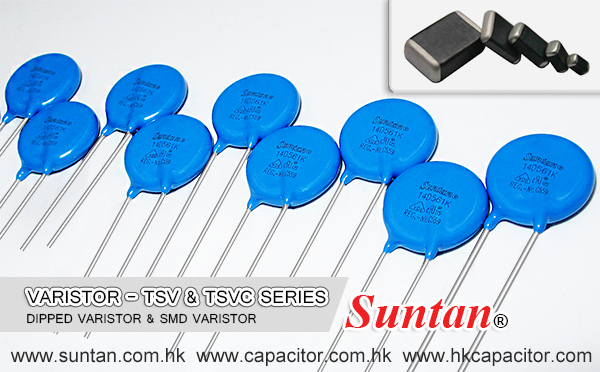
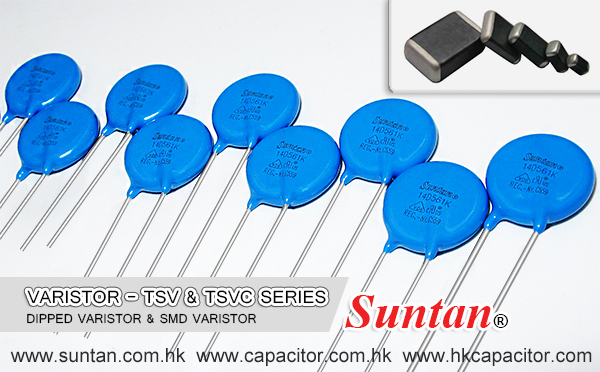
Dipped MOV Varistor – TSV Series
- Radial leaded structure for through-hole assembly
- Higher energy absorption capability
- Suitable for power supply input, adapters and industrial equipment
- Multiple disc sizes for different surge ratings
Datasheet:
TSV Series MOV Varistor
SMD Multilayer Varistor – TSVC Series
- Compact chip design for high-density PCB layouts
- Fast response time for ESD protection
- Low clamping voltage and low leakage current
- Suitable for data lines, consumer electronics and telecom interfaces
Datasheet:
TSVC Series SMD Varistor
Key Selection Parameters
- Varistor voltage (V1mA)
- Clamping voltage
- Peak surge current and energy rating
- Capacitance for high-speed signal applications
- Package size and mounting type
Application Scenarios
- AC power input surge protection
- SMPS and industrial control systems
- Telecommunication equipment
- USB, Ethernet and RF interface ESD protection
- Automotive electronic modules
Conclusion
Dipped MOV varistors are preferred for high-energy surge suppression,
while multilayer SMD varistors are optimized for
fast ESD protection in compact designs.
Selecting the correct varistor requires matching
working voltage, surge capability and capacitance
to the target circuit environment.
For design support or RFQ,
please contact
sales@suntan.com.hk
or
info@suntan.com.hk.